

© 2025 Next Level Business Services Inc. All Rights Reserved.

AI-powered Workforce: What GCC Professional Need by 2028
By NLB Services
India’s Global Capability Center (GCC) ecosystem is undergoing a major structural reset, with artificial intelligence (AI) emerging as a top catalyst. With an AI-powered workforce, GCC centers are shifting from back-office engines to productive innovation hubs. Currently, India is home to over 1700 GCC centers. It is estimated that by the financial year 2028, India will have 2100+ Global Capability Centers (GCC), reflecting an annual compound growth rate of 8%, with an estimate of 150 new centers added annually. As the centers increase, decoding GCC hiring trends is more important than ever to understand the shifting demand for skills, workforce capabilities, and to prepare for the next phase.
Why AI is Reshaping GCC Talent Needs
For GCC leaders, the next 12 to 24 months present a crucial window to restructure and strategically plan for an efficient business operating model. AI transition is being pushed, causing unusual volatility in the talent market. With AI automation of many operational tasks, employees need to push their capabilities from mundane tasks to higher-value functions. The GCC jobs market in India demands talent who can manage, develop, and leverage AI to drive innovation-led work.
India’s GCC ecosystem is now demanding talent that can build, govern, operationalize, and ethically manage AI systems.
Many teams spent most of their time on routine IT support, fixing old systems, manual testing, ERP maintenance, and managing on-premise infrastructure. These tasks are now being automated through AI copilots, cloud platforms, and low-code tools.
According to our latest report, “WORKFORCE 2.0 RESET India’s GCCs Go AI-Native”, jobs that AI transformation is phasing out are:
- L1 IT Support 75% deprioritized
- Legacy App Development 74%
- Manual QA/UAT Testing 72%
- ERP Maintenance 69%
- On-Prem Infrastructure Management 67%
The New AI-Powered Job Landscape
AI development and integration in GCC operations are giving a boost to skill-based jobs, which did not exist a few years ago. To make business AI-ready, GCC leaders need to hire qualified talent and build a robust AI-powered workforce.
As per our latest report, the top emerging roles GCC leaders are focusing on hiring are:
- Cybersecurity & AI Governance Architect 29%
- Prompt Engineer / AI Translator 26%
- GenAI Product Owner 22%
- AI Policy & Risk Strategist 21%
- GenAI Content QA Lead 19%
Currently, even the HR hiring systems are heavily dependent on AI. HRs are now able to source and screen thousands of job applications with AI algorithms, reducing the manual effort and saving time. Candidates also have to optimize their resumes for ATS (Applicant Tracking Systems) to make their application visible.
What GCCs are Prioritising
With better technology, sharper skills, and stronger teams, GCCs are now able to handle entire projects on their own. India’s GCCs are emerging as decision-making centers and are increasingly influencing global strategies.
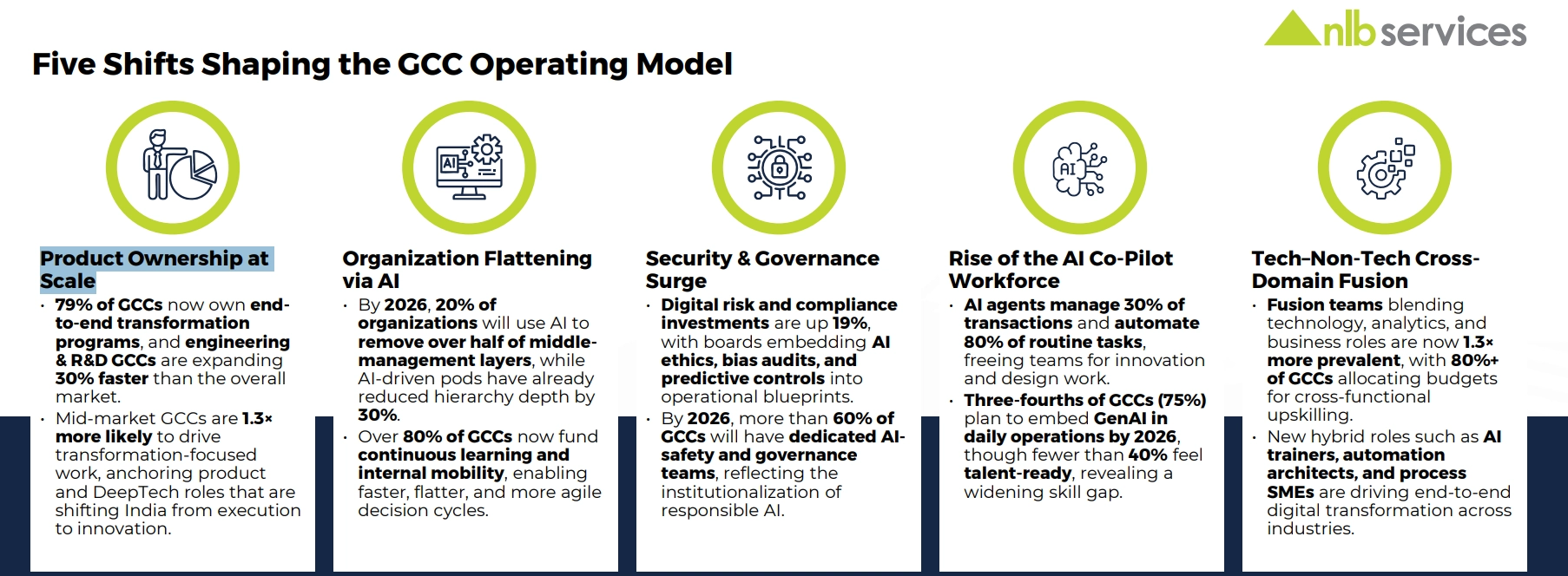
Five major shifts GCC leaders are focusing on to keep them competitive in the market are
Product Ownership at Scale
India’s GCC is contributing to end-to-end product development and transformations. 79% of GCCs now run an end-to-end initiative. It is estimated that mid-market GCCs are 1.3× more likely to lead transformation work.
Organization Flattening via AI
By 2026, about 1 in 5 companies will use AI to cut more than half of their middle-management layers. AI-driven teams have already made organizations 30% flatter, speeding up decisions and reducing hierarchy.
Security & Governance Surge
Rising opportunities also give rise to risks. By 2026, 60% of the GCCs will have a dedicated AI ethical and compliance governance team to institutionalize the responsible use of AI.
Rise of the AI Co-Pilot Workforce
With AI agents, 80% of routine tasks are automated, enabling employees to focus on productive and innovative work. By 2026, 75% of GCCs want GenAI to be part of daily work, but less than 40% feel their teams have the skills for it, showing a growing talent gap.
Tech–Non-Tech CrossDomain Fusion
Teams now mix people from tech, analytics, and business instead of working in separate silos. These blended teams are becoming much more common, and most GCCs are investing in helping employees learn skills outside their core roles.
Top GCC Skills Professionals Need by 2028
Talent shortage and skill gaps will be the biggest challenges for GCCs to expand in India. By 2028, GCCs will have to revamp their workforce and hire based on advanced technical skills and expertise in cloud computing, AI, cybersecurity, and combine with soft skills like teamwork, problem thinking, critical thinking, adaptability, and cross-functional communication.
Artificial Intelligence (AI) and Machine Learning (ML)
AI being the cornerstone of upcoming GCCs’ operational transformation, most in-demand skill areas will involve developing AI solutions, machine learning frameworks (TensorFlow, PyTorch), natural language processing, and computer vision.
Cloud Computing and Architecture
GCCs will aim to hire candidates with expertise in designing blueprints and building cloud infrastructure, and integrating front-end and back-end platforms using platforms like AWS, Azure, and Google Cloud is essential.
Cybersecurity
With the rise in digital operations, safeguarding essential company resources and data becomes the top priority for GCCs. Candidates with skills in threat intelligence, network security, incident response, and risk management are highly valued.
Blockchain Technologies
Integrating blockchain into operations is another key area of growth. Blockchain ensures trust, transparency, and efficiency in multi-stakeholder processes, making it a top priority for GCCs.
How AI Upskilling Can Future-Proof Careers
GCCs are moving away from random or one-time training programs and are now focusing on structured, role-based learning. Instead of giving everyone the same generic courses, they are creating specific learning paths for each job role.
The most popular approach is role-based reskilling or micro-credentials (18%), which means employees learn exactly what their job needs, not unnecessary extras. Close to that are corporate academies and focused training programs (17%), which give employees a clear place to learn and grow. Another rising trend is including AI skills directly into performance reviews and career growth plans (16%), so learning becomes a built-in part of getting promoted and rewarded.
Conclusion
India’s GCC story is changing quickly, and AI is now at the heart of how these centers work and grow. With thoughtful GCC skills development and steady AI upskilling, today’s workforce can move into roles that offer more meaning and impact. As GCC jobs in India continue to rise, people who build both tech and human skills will find themselves ready for the opportunities ahead.
FAQs
Do GCCs prefer upskilling or hiring new talent?
Most GCCs now prefer upskilling existing employees over hiring new talent.
- Upskilling is faster and cost-effective
- It builds internal expertise
- Role-based learning paths make talent future-ready
How can AI upskilling help non-technical professionals?
AI skills help non-tech roles stay relevant and work smarter.
- Automate repetitive tasks
- Improve decision-making with data insights
- Strengthen creativity, communication, and problem-solving using AI tools
Will AI reduce GCC jobs in India?
AI is shifting jobs, not removing them.
- Routine tasks get automated
- New hybrid roles are emerging
- Demand for AI-aware talent is increasing
How long does it take to develop skills for GCC jobs?
Learning time depends on the role, but most skills can be built in 3–12 months.
- Basic AI literacy: a few weeks
- Role-based upskilling: 3–6 months
- Advanced or specialized skills: 6–12 months
What do GCC hiring trends say about AI adoption?
Hiring patterns show that AI adoption is accelerating across GCCs.
- More demand for hybrid tech–business roles
- Reskilling budgets are increasing
- Companies prioritise AI-ready and cross-functional talent